Westminster Shorter Catechism (1647), Westminster Assembly

Question 81

What is forbidden in the tenth commandment?

The tenth commandment forbiddeth all discontentment with our own estate,a envying or grieving at the good of our neighbor,b and all inordinate motions and affections to anything that is his.c

What is forbidden in the tenth commandment?

The tenth commandment forbids all discontentment with our own estate,a envying or grieving at the good of our neighbor,b and all inordinate motions and affections to anything that is his.c

  1. a. 1 Kings 21:4; Esther 5:13; 1 Corinthians 10:10

    1 Kings 21:4

    21:4 And Ahab came into his house heavy and displeased because of the word which Naboth the Jezreelite had spoken to him: for he had said, I will not give thee the inheritance of my fathers. And he laid him down upon his bed, and turned away his face, and would eat no bread.

    21:4 So Ahab went to his palace, sullen and angry because Naboth the Jezreelite had told him, "I will not give you the inheritance of my fathers." He lay down on his bed, turned his face away, and refused to eat.

    Esther 5:13

    5:13 Yet all this availeth me nothing, so long as I see Mordecai the Jew sitting at the king’s gate.

    5:13 Yet none of this satisfies me as long as I see Mordecai the Jew sitting at the king's gate."

    1 Corinthians 10:10

    10:10 Neither murmur ye, as some of them also murmured, and were destroyed of the destroyer.

    10:10 And do not complain, as some of them did, and were killed by the destroying angel.

    King James VersionBerean Standard Bible

  2. b. Galatians 5:26; James 3:14; James 3:16

    Galatians 5:26

    5:26 Let us not be desirous of vain glory, provoking one another, envying one another.

    5:26 Let us not become conceited, provoking and envying one another.

    James 3:14

    3:14 But if ye have bitter envying and strife in your hearts, glory not, and lie not against the truth.

    3:14 But if you harbor bitter jealousy and selfish ambition in your hearts, do not boast in it or deny the truth.

    James 3:16

    3:16 For where envying and strife is, there is confusion and every evil work.

    3:16 For where jealousy and selfish ambition exist, there will be disorder and every evil practice.

    King James VersionBerean Standard Bible

  3. c. Romans 7:7–8; Romans 13:9; Deuteronomy 5:21

    Romans 7:7–8

    7:7 What shall we say then? Is the law sin? God forbid. Nay, I had not known sin, but by the law: for I had not known lust, except the law had said, Thou shalt not covet. 7:8 But sin, taking occasion by the commandment, wrought in me all manner of concupiscence. For without the law sin was dead.

    7:7 What then shall we say? Is the law sin? Certainly not! Indeed, I would not have been mindful of sin if not for the law. For I would not have been aware of coveting if the law had not said, "Do not covet." 7:8 But sin, seizing its opportunity through the commandment, produced in me every kind of covetous desire. For apart from the law, sin is dead.

    Romans 13:9

    13:9 For this, Thou shalt not commit adultery, Thou shalt not kill, Thou shalt not steal, Thou shalt not bear false witness, Thou shalt not covet; and if there be any other commandment, it is briefly comprehended in this saying, namely, Thou shalt love thy neighbour as thyself.

    13:9 The commandments "Do not commit adultery," "Do not murder," "Do not steal," "Do not covet," and any other commandments, are summed up in this one decree: "Love your neighbor as yourself."

    Deuteronomy 5:21

    5:21 Neither shalt thou desire thy neighbour’s wife, neither shalt thou covet thy neighbour’s house, his field, or his manservant, or his maidservant, his ox, or his ass, or any thing that is thy neighbour’s.

    5:21 You shall not covet your neighbor's wife. You shall not covet your neighbor's house or field, or his manservant or maidservant, or his ox or donkey, or anything that belongs to your neighbor."

    King James VersionBerean Standard Bible

Diff style

Changes in The Baptist Catechism (1695), Question 86

No change, but in spelling and punctuation.

No change.

The Baptist Catechism (1695), Question 86

What is forbidden in the tenth commandment?

The tenth commandment forbiddeth all discontentment with our own estate, envying or grieving at the good of our neighbour, and all inordinate motions and affections to anything that is his.

Westminster Shorter Catechism (1647), Question 81

What is forbidden in the tenth commandment?

The tenth commandment forbiddeth all discontentment with our own estate, envying or grieving at the good of our neighbor, and all inordinate motions and affections to anything that is his.

The Baptist Catechism (1695), Question 86

What is forbidden in the tenth commandment?

The tenth commandment forbiddeth all discontentment with our own estate, envying or grieving at the good of our neighbour, and all inordinate motions and affections to anything that is his.

The Baptist Catechism (1695), Question 86

What is forbidden in the tenth commandment?

The tenth commandment forbids all discontentment with our own estate, envying or grieving at the good of our neighbor, and all inordinate motions and affections to anything that is his.

Westminster Shorter Catechism (modernized) (1647), Question 81

What is forbidden in the tenth commandment?

The tenth commandment forbids all discontentment with our own estate, envying or grieving at the good of our neighbor, and all inordinate motions and affections to anything that is his.

The Baptist Catechism (1695), Question 86

What is forbidden in the tenth commandment?

The tenth commandment forbids all discontentment with our own estate, envying or grieving at the good of our neighbor, and all inordinate motions and affections to anything that is his.

Related (1)

Westminster Larger Catechism (1647), parallel to this question

Question 148

What are the sins forbidden in the tenth commandment?

The sins forbidden in the tenth commandment are, discontentment with our own estate; envying and grieving at the good of our neighbor, together with all inordinate motions and affections to anything that is his.

Commentaries (9)

  • Joseph Alleine, 1672, A Most Familiar Explanation of the Assemblies Shorter Catechism

    What is forbidden in the tenth Commandment? The tenth Commandment forbiddeth all discontentment with our own estate, envying or grieving at the good of our neighbour, and all…

    Joseph Alleine’s text
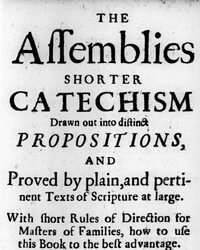
  • Thomas Lye, 1672, The Assemblies Shorter Catechism Drawn out into Distinct Propositions

    What is forbidden in the tenth Commandment? The tenth Commandment forbiddeth all discontentment, with our own estate, envying, or grieving at the good of our neighbour, and all…

    Thomas Lye’s text
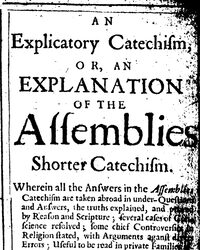
  • Thomas Vincent, 1673, An Explicatory Catechism

    What is forbidden in the tenth Commandment? The tenth Commandment forbiddeth all discontentment with our own estate, envying or grieving at the good of our Neighbour, and all…

    Thomas Vincent’s text
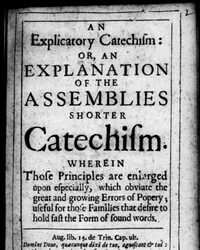
  • 1675, An Explicatory Catechism

    What is forbidden in the tenth Commandment? The tenth Commandment forbiddeth all discontentment with our own estate, envying and grieving at the good of our Neighbour, and all…

    Its text
  • John Flavel, 1692, An Exposition of the Assembly’s Catechism

    Which is the tenth Commandment? The tenth Commandment is, Thou shalt not covet thy Neighbours House, thou shalt not covet thy Neighbours Wife, nor his Man-servant, nor his…

    John Flavel’s text
  • Thomas Watson, 1692, A Body of Practical Divinity (2 parts)

    EXOD. XX. 17. Thou shalt not covet thy Neighbours House, thou shalt not covet thy Neighbours Wife, nor his Man-servant, nor his Maid-servant, nor his Ox, nor his Ass, nor any…

    Thomas Watson’s text
  • Matthew Henry, 1703, A Scripture Catechism

    What is forbidden in the Tenth Commandment? The Tenth Commandment forbiddeth all Discontentment with our own Estate, envying or grieving at the Good of our Neighbour, and all…

    Matthew Henry’s text
  • Alexander Whyte, 1883, A Commentary on the Shorter Catechism

    A peculiar interest attaches to the tenth commandment, from the fact that it was the chief instrument employed by the Holy Ghost in the awakening and conversion of the Apostle…

    Alexander Whyte’s text
  • Benjamin Beddome, 1752, A Scriptural Exposition of the Baptist Catechism

    On The Baptist Catechism (1695), Question 86, which adapts this question

    Is discontent a sin? Yes. The foolishness of man perverteth his way, and his heart fretteth against the Lord, Is envy a sin? Yes. Let us walk honestly as in the day, not in strife…

    Benjamin Beddome’s text