Westminster Shorter Catechism (1647), Westminster Assembly

Question 58

What is required in the fourth commandment?

The fourth commandment requireth the keeping holy to God such set times as he hath appointed in his Word; expressly one whole day in seven, to be a holy sabbath to himself.a

What is required in the fourth commandment?

The fourth commandment requires the keeping holy to God such set times as he has appointed in his Word; expressly one whole day in seven, to be a holy sabbath to himself.a

  1. a. Deuteronomy 5:12–14

    Deuteronomy 5:12–14

    5:12 Keep the sabbath day to sanctify it, as the Lord thy God hath commanded thee. 5:13 Six days thou shalt labour, and do all thy work: 5:14 But the seventh day is the sabbath of the Lord thy God: in it thou shalt not do any work, thou, nor thy son, nor thy daughter, nor thy manservant, nor thy maidservant, nor thine ox, nor thine ass, nor any of thy cattle, nor thy stranger that is within thy gates; that thy manservant and thy maidservant may rest as well as thou.

    5:12 Observe the Sabbath day by keeping it holy, as the LORD your God has commanded you. 5:13 Six days you shall labor and do all your work, 5:14 but the seventh day is a Sabbath to the LORD your God, on which you must not do any work-neither you, nor your son or daughter, nor your manservant or maidservant, nor your ox or donkey or any of your livestock, nor the foreigner within your gates, so that your manservant and maidservant may rest as you do.

    King James VersionBerean Standard Bible
Diff style

Changes in The Baptist Catechism (1695), Question 63

The Baptist Catechism (1695), Question 63

What is required in the fourth commandment?

The fourth commandment requireth the keeping holy to God such set times as he hath appointed in his Word; expressly one whole day in seven to be a holy Sabbath to Himself.

Westminster Shorter Catechism (1647), Question 58

What is required in the fourth commandment?

The fourth commandment requireth the keeping holy to God such set times as he hath appointed in his Word; expressly one whole day in seven, to be a holy sabbath to himself.

The Baptist Catechism (1695), Question 63

What is required in the fourth commandment?

The fourth commandment requireth the keeping holy to God one whole day in seven to be a Sabbath to Himself.

The Baptist Catechism (1695), Question 63

What is required in the fourth commandment?

The fourth commandment requires the keeping holy to God such set times as he has appointed in his Word; expressly one whole day in seven to be a holy Sabbath to Himself.

Westminster Shorter Catechism (modernized) (1647), Question 58

What is required in the fourth commandment?

The fourth commandment requires the keeping holy to God such set times as he has appointed in his Word; expressly one whole day in seven, to be a holy sabbath to himself.

The Baptist Catechism (1695), Question 63

What is required in the fourth commandment?

The fourth commandment requires the keeping holy to God one whole day in seven to be a Sabbath to Himself.

Related (1)

Westminster Larger Catechism (1647), parallel to this question

Question 116

What is required in the fourth commandment?

The fourth commandment requireth of all men the sanctifying or keeping holy to God such set times as he hath appointed in his word, expressly one whole day in seven; which was the seventh from the beginning of the world to the resurrection of Christ, and the first day of the week ever since, and so to continue to the end of the world; which is the Christian sabbath, and in the New Testament called The Lord’s day.

Commentaries (9)

  • Joseph Alleine, 1672, A Most Familiar Explanation of the Assemblies Shorter Catechism

    What is required in the fourth Commandment? The fourth Commandment requireth the keeping holy to God such set times as he hath appointed in his Word; expresly one whole day in…

    Joseph Alleine’s text
  • Thomas Lye, 1672, The Assemblies Shorter Catechism Drawn out into Distinct Propositions

    that We required in the fourth Commandment? The fourth Commandment requireth the keeping holy to God such set times. as he hath appointed in his Word, expresly one whole day in…

    Thomas Lye’s text
  • Thomas Vincent, 1673, An Explicatory Catechism

    What is required in the fourth Commandment? The fourth Commandment requireth the keeping holy to God such set times as he hath appointed in his Word, expressly one whole day in…

    Thomas Vincent’s text
  • 1675, An Explicatory Catechism

    What is required in the fourth Commandment? The fourth Commandment requireth the keeping holy to God, such set times as he hath appointed in his Word; expresly, one whole day in…

    Its text
  • John Flavel, 1692, An Exposition of the Assembly’s Catechism

    Which is the fourth Commandment? The fourth Commandment is, Remember the Sabbath day to keep it holy: Six days shalt thou labour, and do all thy work; but the seventh day is the…

    John Flavel’s text
  • Thomas Watson, 1692, A Body of Practical Divinity

    EXOD. XX. 8. Remember the Sabbath-Day to keep it Holy. Six Days shalt thou labour, and do all thy Work. But the Seventh Day is the Sabbath of the Lord thy God: in it thou shalt…

    Thomas Watson’s text
  • Matthew Henry, 1703, A Scripture Catechism

    What is requir’d in the Fourth Commandment? The Fourth Commandment requires the keeping holy to God such set Times as he hath Appointed in his Word; expresly one whole Day in…

    Matthew Henry’s text
  • Alexander Whyte, 1883, A Commentary on the Shorter Catechism

    Remember the sabbath day—Sabbath is from the Hebrew Shabath, to rest, the day of rest, the Sabbath day. This name is the most ancient name of the day, and till New Testament times…

    Alexander Whyte’s text
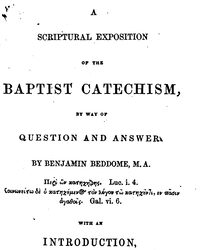
  • Benjamin Beddome, 1752, A Scriptural Exposition of the Baptist Catechism

    On The Baptist Catechism (1695), Question 63, which adapts this question

    Is it the will of God that we should take special notice of the Sabbath? Yes. Remember the Sabbath day, Must we keep holy the Sabbath-day? Yes. Hallow my Sabbaths, Must the…

    Benjamin Beddome’s text