Question 15

Text

What special act of providence did God exercise towards man in the estate wherein he was created?

When God had created man, he entered into a covenant of life with him upon condition of perfect obedience; forbidding him to eat of the tree of the knowledge of good and evil, upon pain of death.a

What special act of providence did God exercise towards man in the estate wherein he was created?

When God had created man, he entered into a covenant of life with him upon condition of perfect obedience; forbidding him to eat of the tree of the knowledge of good and evil, upon pain of death.a

  1. a. Galatians 3:12; Genesis 2:17

    Galatians 3:12

    3:12 And the law is not of faith: but, The man that doeth them shall live in them.

    3:12 The law, however, is not based on faith; on the contrary, "The man who does these things will live by them."

    Genesis 2:17

    2:17 But of the tree of the knowledge of good and evil, thou shalt not eat of it: for in the day that thou eatest thereof thou shalt surely die.

    2:17 but you must not eat from the tree of the knowledge of good and evil; for in the day that you eat of it, you will surely die."

    King James VersionBerean Standard Bible
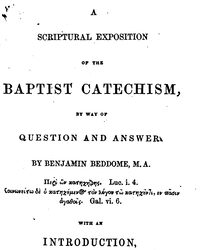
Question 15, sung: The Baptist Catechism Set to Music, Jim Scott Orrick
Diff style

Changes from Westminster Shorter Catechism (1647), Question 12

No change, but in spelling and punctuation.

No change, but in spelling and punctuation.

Westminster Shorter Catechism (1647), Question 12

What special act of providence did God exercise toward towards man in the estate wherein he was created?

When God had created man, he entered into a covenant of life with him upon condition of perfect obedience; forbidding him to eat of the tree of the knowledge of good and evil, upon pain of death.

Westminster Shorter Catechism (1647), Question 12

What special act of providence did God exercise toward man in the estate wherein he was created?

When God had created man, he entered into a covenant of life with him, upon condition of perfect obedience; forbidding him to eat of the tree of the knowledge of good and evil, upon pain of death.

The Baptist Catechism (1695), Question 15

What special act of providence did God exercise towards man in the estate wherein he was created?

When God had created man, he entered into a covenant of life with him upon condition of perfect obedience; forbidding him to eat of the tree of the knowledge of good and evil, upon pain of death.

Westminster Shorter Catechism (1647), Question 12

What special act of providence did God exercise toward towards man in the estate wherein he was created?

When God had created man, he entered into a covenant of life with him upon condition of perfect obedience; forbidding him to eat of the tree of the knowledge of good and evil, upon pain of death.

Westminster Shorter Catechism (1647), Question 12

What special act of providence did God exercise toward man in the estate wherein he was created?

When God had created man, he entered into a covenant of life with him, upon condition of perfect obedience; forbidding him to eat of the tree of the knowledge of good and evil, upon pain of death.

The Baptist Catechism (modernized) (1695), Question 15

What special act of providence did God exercise towards man in the estate wherein he was created?

When God had created man, he entered into a covenant of life with him upon condition of perfect obedience; forbidding him to eat of the tree of the knowledge of good and evil, upon pain of death.

Related (1)

Westminster Larger Catechism (1647), parallel to this question

Question 20

What was the providence of God toward man in the estate in which he was created?

The providence of God toward man in the estate in which he was created, was the placing him in paradise, appointing him to dress it, giving him liberty to eat of the fruit of the earth; putting the creatures under his dominion, and ordaining marriage for his help; affording him communion with himself; instituting the sabbath; entering into a covenant of life with him, upon condition of personal, perfect, and perpetual obedience, of which the tree of life was a pledge; and forbidding to eat of the tree of the knowledge of good and evil, upon the pain of death.

Commentaries (11)